

What Is Shamanic Practice? A Practical Introduction

Shamanic practice is one of those phrases that people often recognise without necessarily knowing what it actually means. You might have heard of shamanic journeying, spirit guides, power animals, ceremonies or working with the elements, but what does a shamanic practitioner actually do?
At its heart, shamanic practice is a way of working with energy, spirit and the natural world - a way of looking more closely at the emotions, patterns, relationships and experiences that don’t always resolve themselves with time alone.
Where shamanic practice comes from
The word shaman comes from the Evenki language of Siberia and is often translated as ‘one who knows’. Traditionally, a shaman was someone their community turned to for guidance, healing and understanding, drawing on their relationship with the natural and spirit world. Over time, the word shamanism came to be used more widely in English, becoming a term for a broad range of spiritual practices found around the world.
Shamanic traditions aren’t all the same. They come from different peoples, places and cultures, each with their own history and way of doing things. I think it’s important to know where the practices we learn come from and to treat them with respect. We can learn from other cultures without simply taking their traditions and making them our own.
A foundational idea within shamanic tradition is that everything is alive and interconnected. Animals, plants, rivers, rocks, wind and the land have a spirit, and more importantly, are not separate from or less important than humans; we are all one part of the same living world. Shamanic practice gives us a way of exploring that relationship, learning from the qualities and characteristics we see in the natural world and bringing them into our own experience. I find that idea particularly important. Everything is energy, and nothing exists in isolation.

My own practice has grown from the shamanic training I have received, but also through working with clients and responding to the different needs they bring. My own experiences and relationship with the natural and spiritual world have shaped it too. I work with spirit guides, ancestors, the elements, journeying, energy and ceremony, each offering a different way of supporting the work we do together.
So what does shamanic practice actually do?
A good starting point is energy, because this is the foundation of the way I understand shamanic work. We are affected by everything we experience - not just in our thoughts and emotions, but in the energy we carry with us afterwards. Some experiences move through us easily; others stay with us, shaping how we feel, how we respond, and the patterns we develop. Life carries on, so we carry on with it, even when we haven't had the time or capacity to properly process what's happened.
That doesn’t mean those experiences disappear. An emotion can remain tucked away inside us for years. A particular person can continue to have an influence over us long after they have left our lives. Sometimes we find ourselves responding to a situation in ways that seem disproportionate to what is happening now because something older is being stirred up. Just understanding an issue intellectually doesn’t mean that we are able to release it.
This is where I see shamanic practice going deeper than many other forms of energy work. Rather than simply working with the energy around an issue, we can begin to look at the emotion, pattern or energetic connection underneath it.
We don’t necessarily need to remember and unpack the detail of how something happened or analyse our entire history. Instead, we work with what is actually present: the emotion, the pattern, the connection or the feeling that something remains unfinished.
Feeling is part of the work
One of the more challenging aspects of shamanic practice is that we are often asked to actually feel what we want to release, and that isn’t always comfortable.
An emotion might have been sitting quietly in the background of your life for years, but if it has started to become disruptive, bringing it into your awareness means allowing yourself to experience it rather than immediately distracting yourself, rationalising it or pushing it away again.
The intention isn’t to make you relive a traumatic experience or spend hours analysing the past. It is about bringing your attention to what is there and working with it.
Sometimes, energetically speaking, that emotion is still associated with the person or situation where it began. It could be an ex-partner, parent, teacher, colleague or somebody else who has had a significant influence on your life. The work gives you an opportunity to say what needs to be said, recognise what belongs to you and what doesn’t, and release what you have continued to carry from that experience.
That is one of the reasons I find this work so empowering. You aren’t simply handing your healing over to somebody else. You are actively involved in your own process of change.
Shamanic practice and times of transition
Much of the work I do is about transition. Life is full of them: relationships beginning and ending, children growing and changing, moving home, changing direction, grief, loss, identity, menopause, starting something new or simply reaching a point where the way we have been living no longer feels right.
Transitions aren’t always about wanting something to change. Sometimes change happens to us, and we have to find a way to move through it. There can be grief for what is ending alongside uncertainty about what comes next. Even when a change is wanted, that doesn’t mean there is nothing to grieve.
This is one of the reasons I describe much of my work as transitional work. I’m interested in what happens in those spaces between one version of our lives and the next, and in creating a safe container while we find our way through them.
Shamanic work gives us space to acknowledge what is happening, honour what is being left behind and make room for whatever comes next. Sometimes that means releasing an emotional connection or something we have been carrying. Sometimes it means finding clarity or guidance. Sometimes there is nothing to fix at all; we simply need somewhere safe to sit with what is happening and allow ourselves to move through it.
The work doesn’t remove the transition or tell you what you should do. It gives you somewhere to meet it, with curiosity, honesty and support, so that you can move forward in a way that feels right for you.
How is shamanic practice different from Reiki?
I am both a Reiki Master and a shamanic practitioner, but I keep these practices very separate. Reiki has its own system, philosophy and way of working; shamanic practice comes from a different framework altogether. I don’t see one as an extension of the other.
One of the clearest differences for me is the level of participation. A Reiki session can be beautifully restful: you lie down, relax and receive. Shamanic work tends to involve you much more directly. You may be asked to journey, explore an emotion, work with an image or symbol, connect with a guide or actively engage with something you are ready to release.
Sound, rhythm and the elements
Sound plays a significant part in shamanic work. Drums, rattles and other instruments create rhythm and vibration, helping to shift energy and awareness and supporting practices such as journeying. The repetitive quality of rhythm gives us something to follow, helping to move us away from the constant chatter of everyday thought.

The elements - Earth, Air, Fire and Water - each carry traditional associations while offering qualities we can explore in relation to our own lives. For me, this relationship with the natural world isn’t separate from everyday life; it’s about becoming more aware of the world around us and our place within it. My own treatment space reflects this, with crystals, essential oils, a medicine blanket and my crow’s wing alongside my drums and rattles. None of it is there simply for decoration.
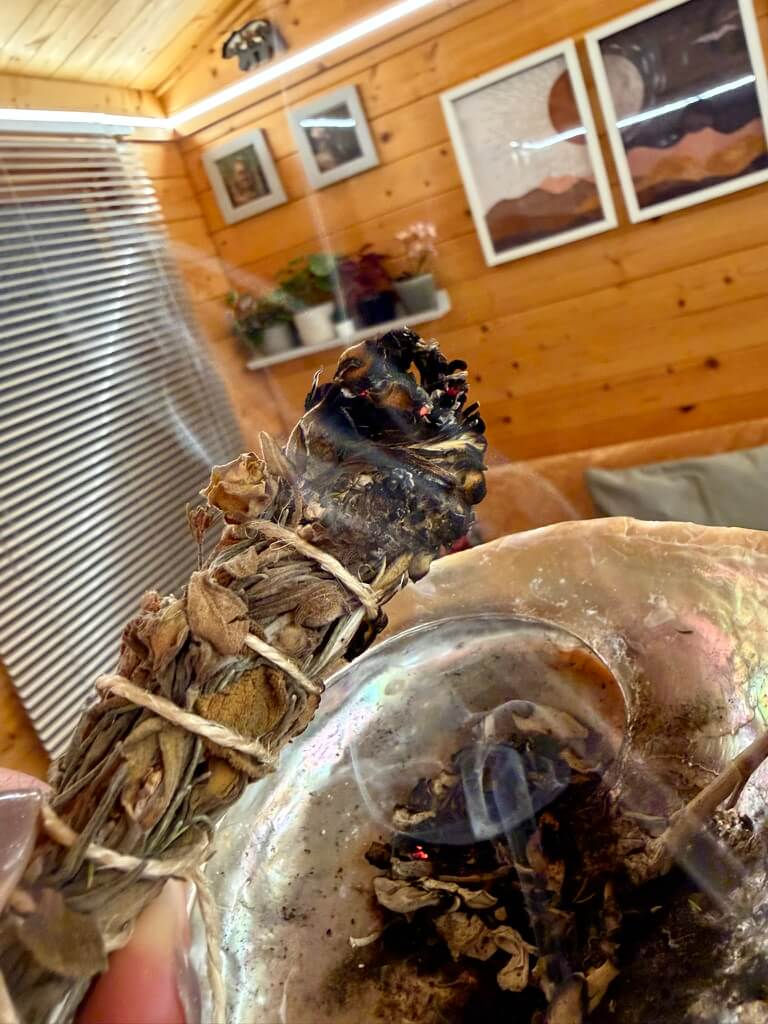
Smoke has a place in my practice too, used for clearing, cleansing and blessing. As my practice has developed, I’ve become more mindful of how I use and describe this work, increasingly using the terms ‘smoke cleansing’ or ‘smoke work’ rather than ‘smudging’. I’m gradually moving away from white sage, which carries specific cultural significance for Indigenous peoples of North America, and exploring herbs more closely connected to where I live, such as rosemary, garden sage and lavender. Cultural origins matter to me, and cultural appropriation is an important conversation within contemporary spiritual practice. Continuing to learn and develop my understanding will always be part of my practice.
What can you use shamanic practice for?
There isn’t one standard shamanic treatment because the starting point depends on what you are bringing to the work.
A Shamanic Energy Balance is useful as a maintenance treatment when nothing specific is calling for attention and you simply feel that things are a little out of whack. Shamanic journeying is particularly useful when you have a question, are facing a decision or want a different perspective on something happening in your life. I may undertake a journey on your behalf, seeking guidance around a particular question or situation, and we then explore what emerges and how it relates to your life. You can also experience journeying for yourself, with me holding and guiding the space.
More targeted processes work with emotional patterns, energetic attachments and relationships that continue to affect us. Womb Healing is a process I particularly enjoy working with, creating space to release experiences and emotions that have been held energetically within the body and to reclaim that space for yourself.
Ceremony offers another way of working when you want to consciously mark something you are releasing, celebrating or changing. It doesn’t have to be elaborate or theatrical. It might be used to honour an ending, welcome a new beginning, acknowledge a transition or simply recognise that something has shifted.
The processes look different, but the underlying principle remains the same: you are actively engaging with your own energy and experience.
Exploring shamanic practice for yourself
You don’t need to completely understand shamanic practice or have any previous experience to take part. Being open-minded and willing to show up for yourself are the only real prerequisites.
However, if you’ve been curious about shamanic practice but haven’t known where to start, my Sacred Journey Circles offer a way to experience this work within a community. The six-session journey brings together a selection of shamanic inspired practices, including energy work, the elements, rhythm and drumming, journeying, guiding forces (spirit or animal guides), power animals, nature and ceremony. The sessions build on one another and culminate in a Winter Solstice closing ceremony.
The circles aren’t about becoming an expert in shamanic practice. They are an opportunity to experience some of the practices for yourself, to learn, to question, to be curious and to see what resonates.
For me, shamanic practice is about creating the space to go deeper: into energy, emotion, patterns, relationships and our connection with the world around us. It is spiritual, but it is also practical. Most importantly, it asks us to take an active role in our own process rather than waiting for somebody else to make the change for us.
If you’ve ever been curious about shamanic practice and would like to experience some of it for yourself within a community, this is your invitation to find out more.

Frequently Asked Questions About Shamanic Practice
What does shamanic practice actually do?
Shamanic practice works with energy, awareness, emotion, patterns and our relationship with the spiritual and natural world. The particular process depends on what you are bringing to the session.
What is the difference between shamanism and Reiki?
Although both work with energy, they come from different traditions and have very different approaches. Reiki is something you receive, whereas shamanic work invites you to take a much more active part.
Is shamanism the same as witchcraft?
No. Shamanism and witchcraft have different histories, traditions and practices, although they are sometimes grouped together because both are associated with spirituality and practices outside mainstream religious traditions.
Does shamanic healing really work?
Research into shamanic healing is still limited, and the existing evidence is not strong enough to establish it as a treatment for medical or psychological conditions. My own understanding comes from my training, my personal experience and the changes I have witnessed in clients. Those experiences are personal rather than scientific proof, and shamanic practice should not replace appropriate medical or psychological care.
Is shamanic healing safe?
As with any wellbeing practice, choosing an appropriately trained practitioner and understanding what the session involves matters. My sessions are carried out within my treatment space, with a consultation where appropriate, and I have health and safety procedures covering the use of smoke, oils, equipment and the treatment environment.
Do shamans believe in God?
There isn’t one answer because shamanic practice isn’t a single religion with one set of beliefs. Different traditions have different understandings of spirit, deities, ancestors and the natural world, and shamanic practice may also exist alongside other religious or spiritual beliefs.
Are there shamans in the UK?
There are people in the UK who describe themselves as shamans or shamanic practitioners, although the meaning of those terms varies. The Society for Shamanic Practice distinguishes between traditional shamans and contemporary shamanic practitioners, and recommends asking about a practitioner’s training and experience.
How do I find a genuine shamanic practitioner?
Ask about their training, experience, approach and the traditions from which they have learned. A responsible practitioner should be open about their background and should not claim to represent an Indigenous tradition or lineage that they have no genuine connection to. The Society for Shamanic Practice also highlights integrity, respect, honesty, appropriate fees and professional boundaries in its code of ethics.
Do I need any previous experience to try shamanic practice?
No. You don’t need previous experience, specialist knowledge or an established spiritual practice to attend a session with me. Everything you need to know will be explained as we go.
What happens during a shamanic journey?
We begin by discussing what you want guidance around. I then undertake the journey and, afterwards, we explore what emerged and how it relates to you.
How much does a shamanic session cost?
My current Shamanic Journey session is £60 for one hour, and Connect with Your Power Animal is £75 for 1 hour 15 minutes. Other shamanic processes are 90 minutes and £90.


Comments